
Peter in the Courtyard
Praying the Gospel of Mark, Holy Week, Tuesday. (Mark 14:66-72)

Audio Post: (Also available on The Friendship with Jesus Podcast on Spotify, Apple, etc)
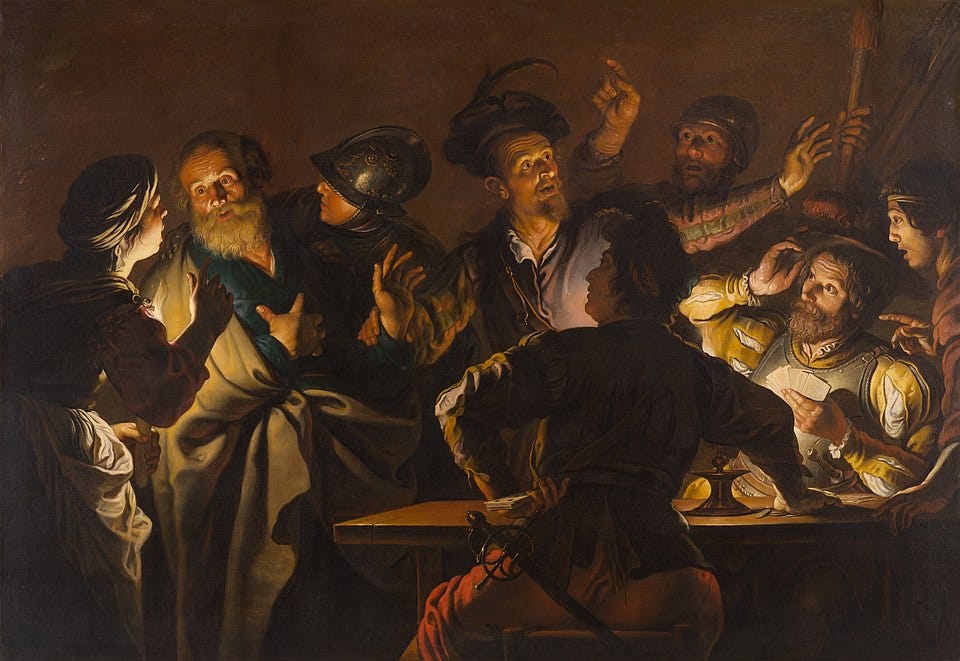
Jesus is being mocked and accused of all kinds of crimes inside the Sanhedrin’s chamber rooms. Outside in the courtyard, Peter has followed at a distance and sits around a fire warming himself.
Here’s the story:
While Peter was below in the courtyard, one of the servant girls of the high priest came by. When she saw Peter warming himself, she looked closely at him.
“You also were with that Nazarene, Jesus,” she said.
But he denied it. “I don’t know or understand what you’re talking about,” he said, and went out into the entryway. When the servant girl saw him there, she said again to those standing around, “This fellow is one of them.” Again he denied it.
After a little while, those standing near said to Peter, “Surely you are one of them, for you are a Galilean.” He began to call down curses, and he swore to them, “I don’t know this man you’re talking about.”
Immediately the rooster crowed the second time. Then Peter remembered the word Jesus had spoken to him: “Before the rooster crows twice you will disown me three times.” And he broke down and wept.
The Story in the Middle
In Mark’s telling of Jesus’ passion, he places this story between the two trials, the Jewish trial and the Roman trial. We have seen Mark do this several times throughout his gospel, placing one story in the middle of another, in order to invite us to listen as the stories talk to one another. One way they are doing this here is to see the universal rejection of Jesus, by the religious authorities of the Sanhedrin, the political authorities, represented by Pilate, and devastatingly, right at the center, his personal friends reject him as well. Every arena of Jesus’ life is arrayed against him.
One is reminded of Isaiah 53:6, “We all, like sheep, have gone astray, each of us has turned to our own way; and the Lord has laid on him the iniquity of us all.”

That verse is followed immediately by Isaiah’s prophecy about the Suffering Servant remaining silent before his accusers. We have seen Jesus doing that, as he will again before Pilate, but Mark highlights it even more by juxtaposing Peter’s verbal outbursts. Before false accusations, Jesus remains silent. Before true accusations, Peter vehemently denies them, eventually calling down curses and swearing he does not know who Jesus is. This is the kind of justification and self-preservation tactics we expect from Jesus to defend himself. But he won’t do it. By contrast, Peter’s outburst highlights even more the power of Jesus’ silence.
Motivations
I wrote last year about this story and about what might have been Peter’s motivations. You can find that here:

I always thought that Peter was afraid so his denial is a form of self preservation. But his being in the courtyard at all seems to speak against this. Perhaps, as I have wondered, he was embarrassed to be associated with Jesus, this very non-King like Messiah. Perhaps.
This year, my mind goes to what Mark has said about his motivation – exactly nothing. The same is true of Judas. We do not know the inner workings of these men’s minds that led them to do what they did. And perhaps that is the point. Why they did it is far less important than that they did it.
We live in an age that loves to parse all the psychological nuances, reasonings, and traumas that lead us to do the things we do. All of that can be extremely helpful, to be sure, but I wonder if Mark would bring a cautionary word. It is true that writing in the first century did not include all the inner psychological landscapes that we are accustomed to today. What was important to them was what people actually did. At the end of the day, perhaps Mark would say to us, it doesn’t matter why Peter denied Jesus. He did it. And that is what Jesus sees and forgives. I am sobered by this. I can fool myself into thinking that all my inner movements of thought and spirit are what matters. Mark might well ask me, (and you?) ‘Well, that’s nice, but what have you done?’
We might want to hold this question as we watch Peter in the courtyard.
Let’s pray the story.
Father, animate my spirit and imagination as I seek to accompany you, Jesus, in your final hours before you died. Open the eyes and ears of my heart, Spirit, that I might receive what you want to reveal to me today.
Prayer: Peter in the Courtyard
(You can listen to the prayer by itself here. The text follows, if you’d rather read it.)
You can’t stay here. The sound of fists hitting Jesus, soldiers spitting . . . you have to get out of here. You make your way out of the chamber, being careful that no one sees you. Everyone is clamouring around Jesus. No one notices you.
You get to an outside door and push it open. The night air rushes at you, momentarily cleansing you from the stuffy, angry atmosphere of the Sanhedrin’s chambers. You can still hear the jeers of the soldiers, until the door slams shut behind you. You lean back against the wall, taking a moment.
When you open your eyes you realize there are people all around, moving about slowly, not really going anywhere, waiting, speaking softly to each other. You move, unsure where to go but hoping a gate will present itself so you can get out of this courtyard. Small fires are scattered all around, warming the people gathered around them, some soldiers, some workers.
“I don’t know what you’re talking about!” It’s Peter’s voice. You recognize it instantly. You thought all the disciples were long gone. You’re glad to hear a familiar voice. Maybe he will know what to do.
You see a figure rise and walk toward the entryway of the courtyard. You only see his back but you know it’s Peter. You move to approach him. A young servant girl is following him and pulling on people’s sleeves to beckon them to follow her. She points at Peter and says to her companions, “This one. This man is one of them.” The others move in closer to see for themselves when Peter spins around, “Get away from me. I don’t understand what you’re even saying!”
The little group disperses. You stand, stunned. What has Peter said? You step back into the shadows, unnerved. You were about to grab hold of Peter’s cloak but now, with this, you’re not sure what you should do. Peter has been your leader and your friend. He was always the one stepping forward to go with Jesus, to trust him, to protect him. It was Peter who walked on the water, who went with Jesus to see the little girl raised back to life, who saw Jesus shining on the mountain. He was in Jesus’ inner circle. What has happened?
It was only a couple hours ago when you heard him say he would die with Jesus. You were amazed at his conviction, at his fearlessless, his courage.
Your mind swirls, trying to make sense of what you’ve just witnessed when another group approach Peter, standing a little way off now. “Surely you are one of them. We can hear your accent. You’re a Galilean. You are one of the man’s disciples.”
“Curses! May curses fall on me if I am lying. I do not know the man! Now leave me alone!” Before he finishes, you hear it like a knife thrown through the air with deadly precision – the rooster crow. Peter’s eyes widen and he falls to the ground, overcome with emotion. Jesus had said exactly this, “Before the rooster crows, you will deny me three times.”
The group surrounding him leave him alone as he crumples to the ground. You stand there, watching, waiting. Wondering.
Do not leave too quickly. As you wait with Peter, what goes though your mind?
Spend a few moments here.
Amen and amen. Thanks for praying. Until tomorrow.